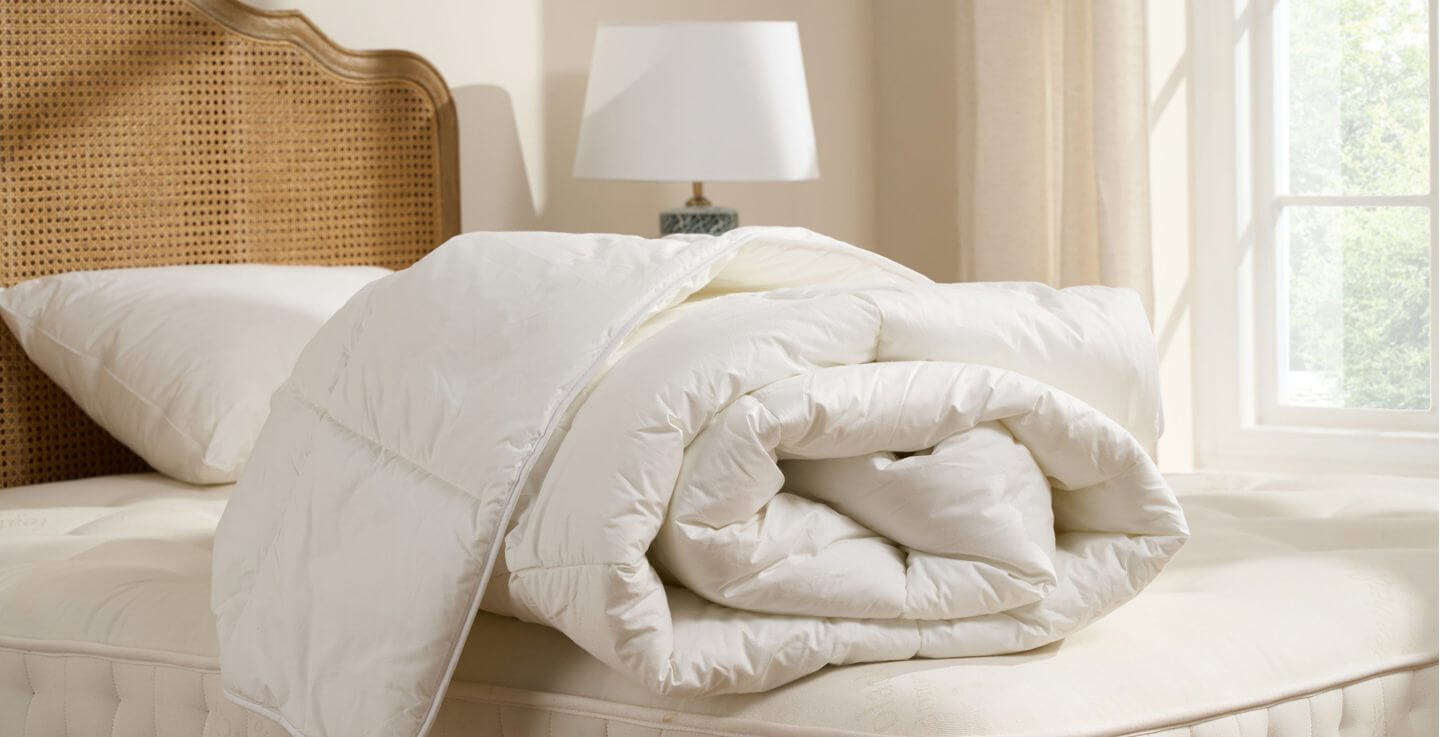
Duvets
Our meticulously crafted duvets deliver unparalleled comfort and precise temperature control. Sourced from the finest natural materials, our collection features buoyant Hungarian goose down, insulating White Snow duck feather, and breathable British wool to transform your sleep. Experience weightless warmth, remarkable loft, and peerless craftsmanship.
-
Black Friday
Black Friday
Luxury British Wool Duvet
(5)
30%
off £149 from £104 -
Black Friday
Black Friday
White Snow Duck Down and Feather Duvet
(1)
40%
off £169 from £101 -
Black Friday
Black Friday
Hungarian Goose Down Duvet
(6)
40%
off £199 from £119 -
Black Friday
Black Friday
Soft as Down Deluxe Duvet
(4)
10%
off £89 from £80 -
Black Friday
Black Friday
Vispring Pure British Wool 10 Tog Duvet
20%
off £395 from £316
Understanding Tog Ratings and Seasonal Warmth
A luxury duvet regulates body temperature through thermal resistance, measured universally on the Tog (Thermal Overall Grade) scale. Lower tog ratings, such as 4.5 tog, maintain high airflow to dissipate excess heat in summer or warm bedrooms. Medium ratings of 9 tog and 10.5 tog provide balanced insulation for transitional spring and autumn conditions. For cold winters, 13.5 tog duvets provide high thermal containment.
Choosing the right tog prevents nocturnal overheating and sleep disruption. Natural fillings achieve superior tog ratings with significantly less weight than synthetic alternatives, delivering warmth without physical restriction. Explore our definitive guide to duvet togs for every season to select the right thermal resistance for your bedroom.
Balancing Weightless Warmth Against Grounded Drape
Physical comfort depends on fill structure. A duck down duvet harnesses three-dimensional, quill-free clusters that expand into an intricate lattice of trapped air. This structure delivers superior thermal retention with almost imperceptible downward pressure, engineered for sleepers who move frequently through the night.
A duck feather duvet incorporates curved feathers with supple central spines. This structure provides a firm, reassuring drape that settles closely against the mattress, preventing cold air from entering at the side of the bed. Both fills offer natural breathability and resilience. Discover how ratios shape comfort and insulation in our expert comparative guide to feather and down.
Why British Wool Solves Temperature Spikes
Disrupted rest frequently stems from trapped humidity rather than room temperature alone. Synthetic fills trap moist air against the skin, triggering sudden overheating. Naturally hygroscopic wool duvets provide an active remedy. The crimped fibres within a British wool duvet absorb up to 30% of their dry weight in moisture vapour, releasing it evenly into the room to maintain a consistently dry, balanced sleeping climate.
This dynamic breathability establishes wool as an exceptional filling for warm sleepers and couples with different temperature preferences. Discover dedicated cooling solutions in our guide to the best duvets for hot sleepers.
The Designer Principle of Generous Drape
A duvet should extend beyond the surface area of the mattress to seal in warmth and create a tailored, hotel-standard aesthetic. For king and super king beds, selecting a duvet one size larger than your mattress provides an indulgent, sweeping drape across the bed frame while completely eliminating the tug-of-war for covers between partners.
Frequently Asked Questions
A luxury duvet protected by a quality duvet cover requires laundering once every six to twelve months. Regular airing on a dry, breezy day refreshes the fibres and redistributes natural oils. Natural down, feather, and wool duvets should always be cleaned in accordance with their care labels, ideally by a professional.
A high-grade natural down or feather duvet maintains its loft and insulating capability for 10 to 15 years with appropriate care. Wool duvets hold their resilience for roughly 8 to 12 years. Synthetic duvets typically compact, lose thermal consistency, and require replacement every 2 to 4 years.
Store natural down, feather, and wool duvets in breathable cotton bags rather than vacuum-sealed plastic bags. Vacuum compression crushes the delicate structure of down clusters and crimped wool fibres, while airtight plastic traps ambient humidity and can cause mildew. Ensure the duvet is thoroughly clean and dry before storing it in a cool, well-ventilated wardrobe.
Restoring volume to a down duvet requires air and gentle agitation. Place the duvet in a large tumble dryer on the lowest heat setting alongside two or three clean wool dryer balls for 20 to 30 minutes. The gentle movement aerates the down filaments, separating the clusters and restoring their natural three-dimensional loft.
Yes, partners with different temperature preferences can share a duvet. A British wool duvet dynamically self-regulates across both sides of the bed by balancing individual moisture zones. Alternatively, adopting the Scandinavian sleep method - dressing a double, king, or super king bed with two individual single duvets tailored to each sleeper's chosen tog rating - eliminates temperature friction.
A duvet requires replacement when it becomes uneven with lumpy sections that no longer redistribute after shaking, or after an overall loss of loft and thickness. Other indicators include discolouration from natural body oils penetrating the casing or feathers consistently poking through degraded fabric seams.
Natural feather, down, and wool fills are inherently biodegradable and circular, meaning their components can often be repurposed rather than sent to landfill. Dedicated textile recycling banks and local council recycling centres process natural fibres into insulation, compost, or carpet underlay. Clean, laundered duvets in sound condition can also be donated directly to local animal rescue centres and wildlife shelters to provide warm bedding.
A 9-tog or 10.5-tog duvet provides balanced warmth across spring and autumn in moderately heated homes.
No. Weight does not equal thermal warmth. Natural down has a remarkably high warmth-to-weight ratio, providing superior insulation while remaining virtually weightless. In contrast, feather and synthetic hollowfibre fills require significantly more weight to achieve the same tog rating as pure down.